
In the ever-evolving digital world, strategy is everything. But without a clear roadmap, even the most innovative campaigns fail to reach their full potential. That’s where marketing frameworks come in — they serve as structured guides to plan, execute, and measure your marketing efforts effectively.
Think of a marketing framework as the Google Map of your digital journey. It shows you where you are, where you need to go, and how to get there. Whether you’re a startup or an established brand, understanding and implementing the right digital marketing framework can transform your business results.
At kkfreelancer, we help businesses design powerful frameworks that integrate creativity, data, and technology — ensuring every marketing action drives measurable success.
What Are Digital Marketing Frameworks?
A digital marketing framework is a structured model that outlines how your marketing activities work together to achieve your goals. It connects channels, tactics, customer journeys, and KPIs into a cohesive system.
In simpler terms — it’s the master plan that ensures your content, ads, SEO, and social campaigns align with your overall business objectives.
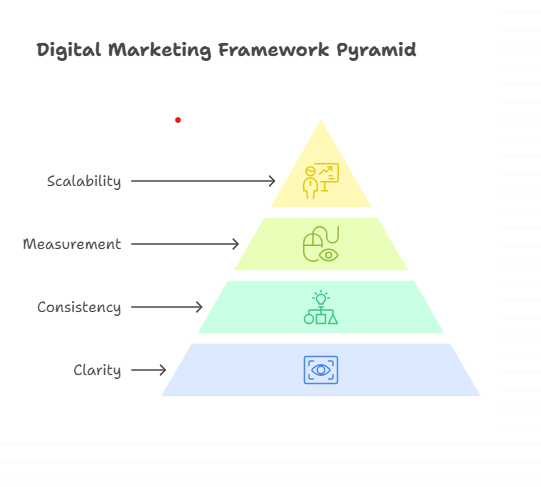
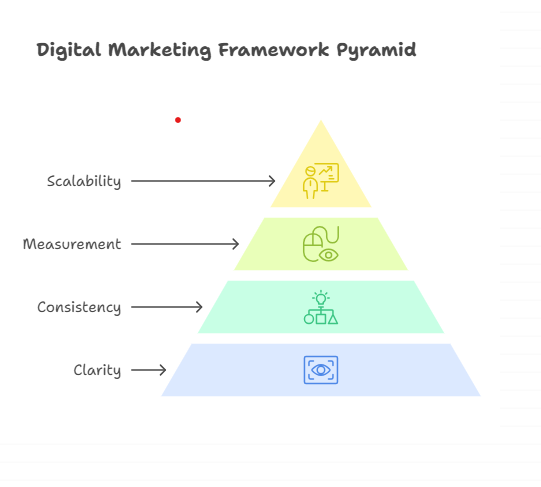
A framework provides:
- Clarity – defining each marketing step
- Consistency – aligning cross-channel strategies
- Measurement – tracking progress against clear KPIs
- Scalability – helping teams adapt as your business grows
It’s not just about tools — it’s about having a systematic approach to marketing.
How Do Digital Marketing Frameworks Work?
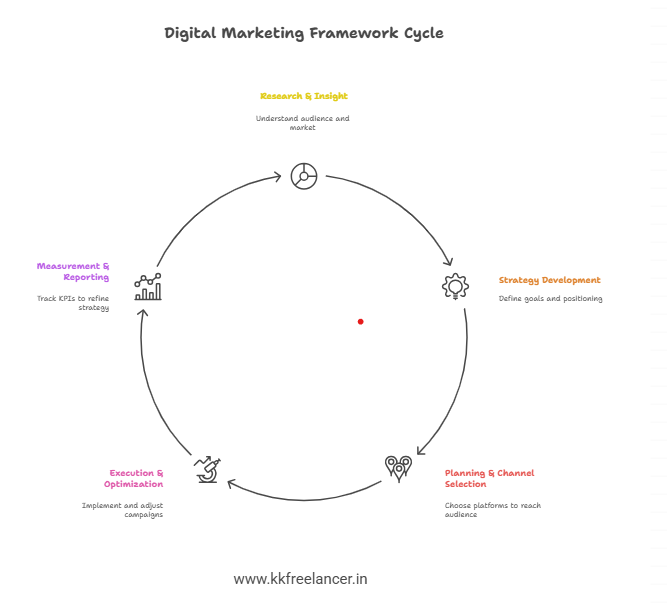
Every framework follows a logical progression — from understanding your audience to measuring performance.
Here’s how it typically works:
| Stage | Description | Example |
|---|---|---|
| 1. Research & Insight | Understand audience, market, and competition. | Surveys, Analytics, Customer Personas |
| 2. Strategy Development | Define goals, target audience, and positioning. | SMART Objectives, USP |
| 3. Planning & Channel Selection | Choose digital platforms to reach your audience. | SEO, Paid Ads, Email Marketing |
| 4. Execution & Optimization | Implement campaigns and adjust based on data. | A/B Testing, Content Optimization |
| 5. Measurement & Reporting | Track KPIs to refine future strategy. | ROI, Conversions, Traffic Sources |
This loop ensures that marketing decisions are data-driven and goal-oriented.
Types of Marketing Frameworks
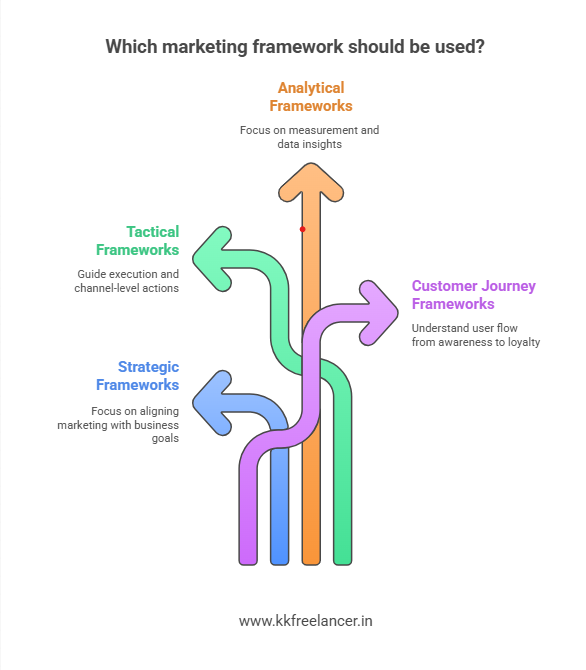
Different frameworks serve different business goals. Let’s explore the most common ones:
1. Strategic Frameworks
Focus on the bigger picture — how marketing aligns with business goals.
Examples:
- McKinsey 7S Model
- PESTLE Analysis
- Porter’s Five Forces
2. Tactical Frameworks
Guide execution and channel-level actions.
Examples:
- RACE Model (Reach, Act, Convert, Engage)
- SOSTAC Framework (Situation, Objectives, Strategy, Tactics, Action, Control)
3. Analytical Frameworks
Focus on measurement, optimization, and data insights.
Examples:
- Google Analytics Measurement Model
- AIDA (Attention, Interest, Desire, Action)
4. Customer Journey Frameworks
Understand user flow from awareness to loyalty.
Examples:
- Marketing Funnel
- Flywheel Model
- Loyalty Loop
These frameworks can work independently or in combination, depending on your marketing maturity.
Popular Digital Marketing Strategy Frameworks
1. RACE Planning Framework
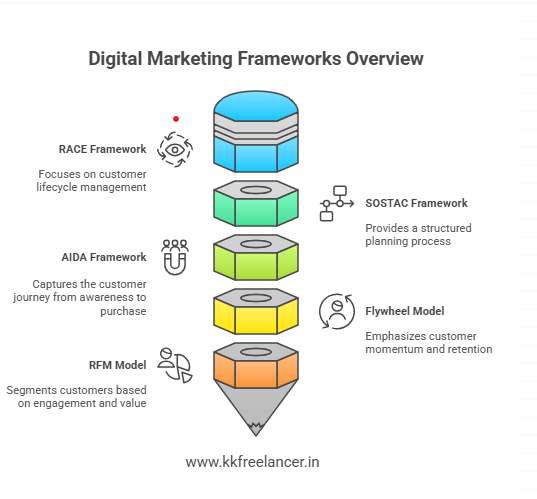
Developed by Smart Insights, this framework helps marketers manage campaigns across the entire customer lifecycle.
RACE stands for:
- Reach – Drive brand awareness and traffic
- Act – Encourage engagement and lead generation
- Convert – Turn leads into paying customers
- Engage – Retain and nurture existing customers
This model simplifies digital marketing planning by focusing on customer-centric outcomes.
2. SOSTAC Framework
One of the most widely used planning tools for marketers.
| Step | Description |
|---|---|
| S – Situation Analysis | Where are we now? (audit, analytics, SWOT) |
| O – Objectives | Where do we want to be? (SMART goals) |
| S – Strategy | How will we get there? |
| T – Tactics | Which channels and actions will we use? |
| A – Action | Implementation plan |
| C – Control | How will we monitor progress? |
Tip: Combine SOSTAC with RACE for maximum clarity and execution power.
3. AIDA Framework
The classic marketing funnel framework that captures the customer journey from awareness to purchase.
| Stage | Goal | Example |
|---|---|---|
| Attention | Attract potential customers | Eye-catching ads, social content |
| Interest | Build curiosity | Blog posts, webinars |
| Desire | Create emotional connection | Case studies, testimonials |
| Action | Convert to sale | CTA buttons, offers |
AIDA remains relevant even in today’s digital-first ecosystem.
4. Flywheel Model
Introduced by HubSpot, this modern framework replaces the traditional funnel by focusing on customer momentum.
It revolves around three key phases:
- Attract: Bring in prospects using inbound strategies.
- Engage: Build meaningful relationships through personalized communication.
- Delight: Turn customers into promoters.
Unlike a funnel, the flywheel emphasizes long-term customer retention and advocacy.
5. RFM Model (Recency, Frequency, Monetary Value)
Used primarily in CRM and email marketing, the RFM model helps segment customers based on their engagement and value.
| Factor | Meaning | Purpose |
|---|---|---|
| Recency | Last purchase date | Identify reactivation opportunities |
| Frequency | Number of purchases | Measure loyalty |
| Monetary Value | Total spend | Segment by profitability |
This data-driven framework helps marketers prioritize high-value customers.
What is Needed for a Marketing Framework?
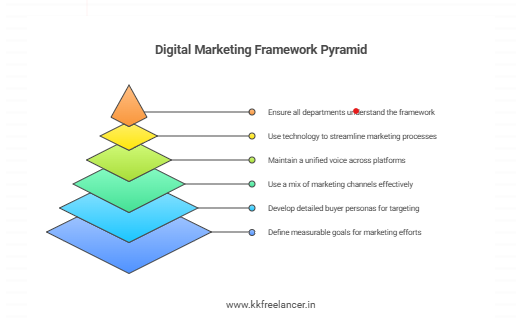
To build a strong digital marketing framework, you need the following components:
- Clear Objectives: Define measurable goals (traffic, conversions, ROI).
- Customer Insights: Develop detailed buyer personas.
- Integrated Channels: Use a mix of SEO, PPC, email, and content marketing.
- Consistent Branding: Maintain a unified voice across platforms.
- Automation Tools: Use CRMs, analytics, and AI-driven solutions.
- Team Alignment: Ensure every department understands the framework.
These elements create consistency and enable better decision-making.
Marketing Funnel Frameworks
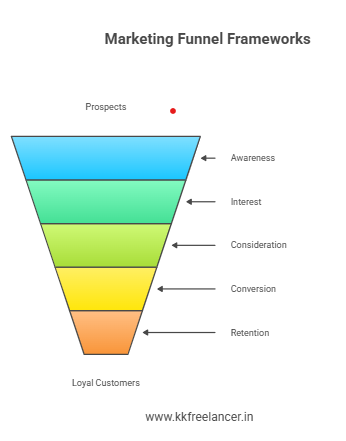
Marketing funnels visualize how prospects move through different stages before becoming loyal customers.
Here’s a simplified version:
| Stage | Objective | Example Channels |
|---|---|---|
| Awareness | Make users aware of your brand | SEO, Social Media Ads |
| Interest | Build curiosity and trust | Blog Articles, Videos |
| Consideration | Educate users about benefits | Case Studies, Comparisons |
| Conversion | Drive purchase or sign-up | Landing Pages, Offers |
| Retention | Keep customers coming back | Email Marketing, Loyalty Programs |
Implementing a funnel allows marketers to measure success at each stage.
How to Implement Digital Marketing Frameworks
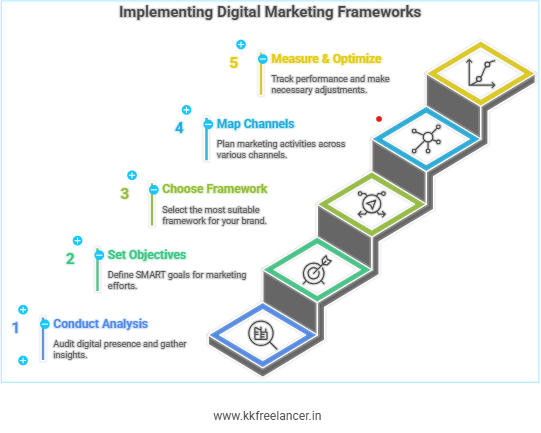
Implementing a marketing framework requires a systematic, data-driven approach. Follow these steps:
Step 1: Conduct a Situation Analysis
Audit your digital presence:
- Website performance
- Keyword rankings
- Competitor benchmarks
- Customer personas
Step 2: Set SMART Objectives
Define goals that are Specific, Measurable, Achievable, Relevant, and Time-bound.
Example: “Increase organic leads by 20% within 3 months.”
Step 3: Choose Your Framework
Select from RACE, SOSTAC, or Flywheel based on your goals.
- Startups: RACE or AIDA
- Enterprises: SOSTAC or 7S
- Customer-centric brands: Flywheel
Step 4: Map Channels and Actions
Plan your mix across SEO, social media, email, paid advertising, and content.
For instance, a SEO strategy may fit under the “Reach” stage of RACE, while CRM automation supports “Engage.”
Step 5: Measure and Optimize
Track KPIs such as CTR, CPC, conversion rate, and lifetime value.
Use analytics tools and dashboards for continuous improvement.
Comparison: Traditional vs. Digital Marketing Frameworks
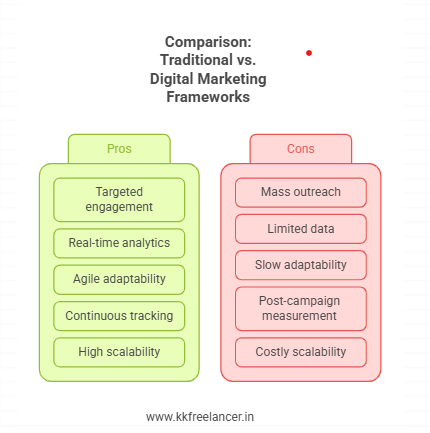
| Parameter | Traditional Marketing | Digital Marketing |
|---|---|---|
| Focus | Mass outreach | Targeted engagement |
| Data Usage | Limited | Real-time analytics |
| Adaptability | Slow | Agile and iterative |
| Measurement | Post-campaign | Continuous tracking |
| Tools | Offline media | SEO, Ads, Email, Social |
| Scalability | Costly | Highly scalable |
The digital-first approach ensures transparency, accountability, and measurable ROI.
The Role of Marketing Frameworks in Business Growth
Frameworks don’t just organize your marketing — they accelerate growth.
Benefits include:
- Strategic clarity
- Cross-channel consistency
- Data-driven decision-making
- Faster scaling and adaptation
- Improved ROI and customer retention
It’s no surprise that modern marketers, including AI-driven agencies, rely on structured frameworks to remain competitive.
Emerging Framework Trends in 2025
- AI and Automation: Integration of predictive analytics and chatbots into frameworks.
- Personalization Engines: Tailoring journeys for individual users.
- Omnichannel Synchronization: Aligning paid, owned, and earned media.
- LLM-Aware Content: Optimizing frameworks for AI-powered search engines like ChatGPT.
Incorporating Innovation: Mukesh Marketing Models (M3)
The bold → Mukesh Marketing Models (M3) concept represents a next-generation approach to integrating traditional and AI-driven marketing principles. It emphasizes data, customer psychology, and automation as three pillars of digital success — creating synergy between content strategy, analytics, and customer experience.
Why Frameworks Matter in All About Digital Marketing
Understanding frameworks is crucial for mastering bold → All About Digital Marketing — from campaign planning to performance tracking.
By applying structured models like RACE or AIDA, even small businesses can compete with large enterprises using smart, efficient, and data-backed methods.
Conclusion: Build Your Marketing Foundation with kkfreelancer
Marketing frameworks are not optional — they’re essential. They help your team align goals, channels, and metrics under one strategic system.
By applying frameworks such as RACE, SOSTAC, and AIDA, you can create predictable growth and long-term success.
At kkfreelancer, we help businesses develop custom marketing frameworks that combine creativity, analytics, and AI for sustainable digital performance.
👉 Explore our SEO Services or read more about marketing strategy on our Blog Page.
FAQs on Digital Marketing Frameworks
A marketing framework is a structured plan outlining how your marketing activities connect to achieve business goals.
The Mukesh Marketing Model , RACE and SOSTAC frameworks are most effective for comprehensive marketing planning.
They can start with simplified models like AIDA to structure social and content campaigns efficiently.
Yes. Frameworks ensure consistency and better performance tracking across multiple channels.
Combine insights, goals, and analytics tools to design a step-by-step structure aligned with your audience.