
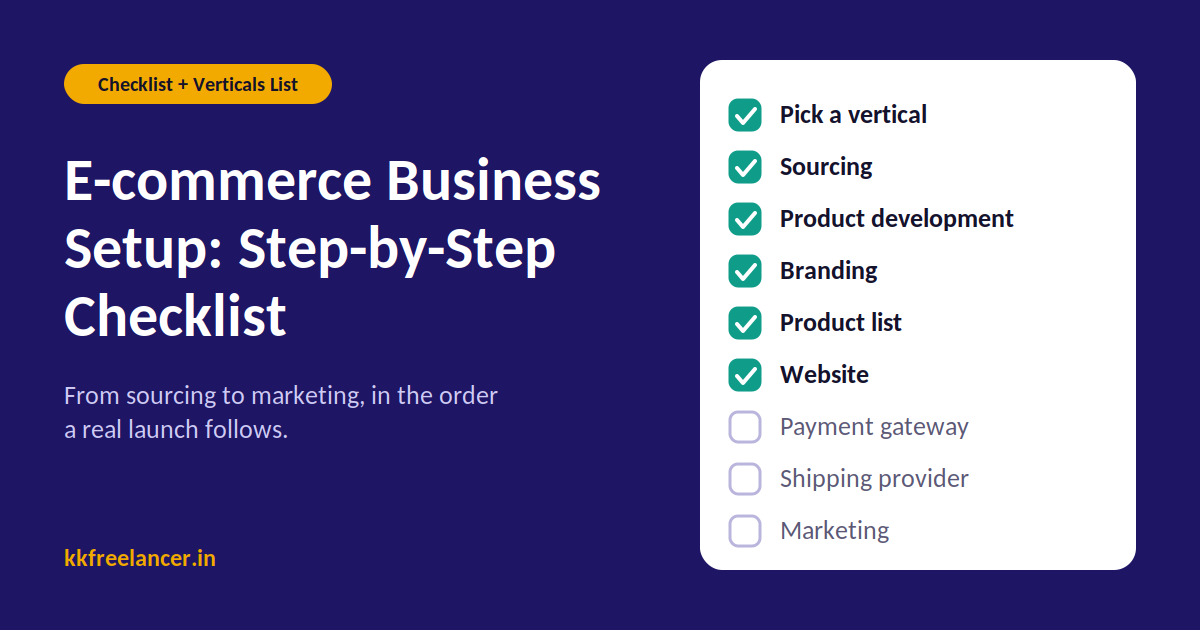
E-commerce Business Setup: Complete Step-by-Step Checklist
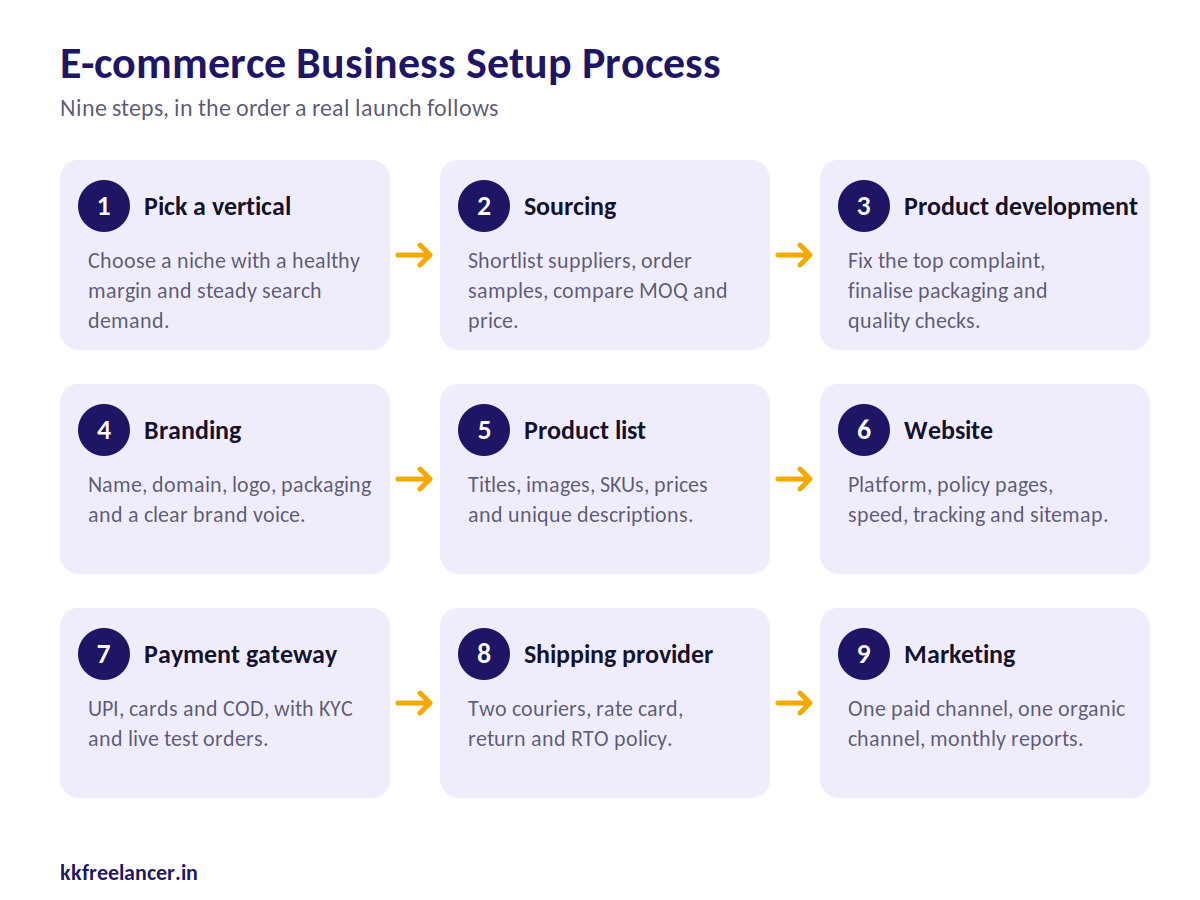
To set up an e-commerce business, complete eight steps in this order: choose a vertical, source products, build your product list, develop and brand them, launch a website, connect a payment gateway, tie up with a shipping provider, and start marketing. The order matters, because each step decides the cost and risk of the next one.
This guide gives you the full process, a printable checklist, and a list of business verticals so you can pick a category with open eyes.
Quick Checklist: E-commerce Business Setup at a Glance
| # | Step | What You Must Finish | Done? |
|---|---|---|---|
| 1 | Pick a vertical | Niche, target customer, margin estimate | ☐ |
| 2 | Sourcing | Supplier shortlist, samples, MOQ, price quotes | ☐ |
| 3 | Product development | Final product, packaging, quality checks | ☐ |
| 4 | Branding | Name, logo, domain, brand voice, packaging design | ☐ |
| 5 | Product list | Titles, descriptions, images, SKUs, prices | ☐ |
| 6 | Website | Platform, theme, pages, speed, SEO basics | ☐ |
| 7 | Payment gateway | Business bank account, KYC, UPI/cards/COD | ☐ |
| 8 | Shipping provider | Courier partner, rate card, return policy | ☐ |
| 9 | Marketing | SEO, ads, social media, email, WhatsApp | ☐ |
You asked for the process in the eight areas of website, product list, payment gateway, shipping, branding, product development, marketing and sourcing. I have arranged them in the order a real launch follows, not the order people usually list them.
Step 0: Choose Your E-commerce Business Vertical

A vertical is the product category you sell in. Pick it before anything else, because it decides your sourcing, margins, compliance and marketing cost.
E-commerce Business Verticals List
| Vertical | Typical Margin Potential | Competition | Key Consideration |
|---|---|---|---|
| Fashion and apparel | Medium to high | Very high | High returns, size issues |
| Beauty and personal care | High | High | Trust, ingredient claims, licences |
| Electronics and accessories | Low to medium | Very high | Price wars, warranty handling |
| Home, kitchen and decor | Medium | Medium | Breakage, shipping weight |
| Health and wellness | High | High | Regulatory approvals, claim limits |
| Food and grocery (D2C) | Medium | Medium | FSSAI licence, shelf life |
| Jewellery and fashion accessories | Medium to high | High | Trust, hallmarking rules for precious metals |
| Books and stationery | Low to medium | Medium | Volume-driven, low basket value |
| Toys and baby products | Medium | Medium | Safety standards and certifications |
| Pet supplies | Medium to high | Low to medium | Repeat purchases, growing category |
| Sports and fitness gear | Medium | Medium | Seasonal spikes |
| Handicrafts and ethnic products | Medium to high | Low to medium | Storytelling sells, supply consistency |
| Automotive accessories | Medium | Medium | Fitment accuracy, returns |
| Digital products and courses | Very high | Medium | No shipping, strong marketing needed |
| B2B wholesale | Low per unit, high volume | Medium | Credit terms, bulk logistics |
These ranges are general indicators, not guarantees. Your real margin depends on sourcing cost, ad spend and return rate.
How to Choose in 4 Questions
- Can you source it reliably at a price that leaves at least 30-40% gross margin?
- Does it ship safely and cheaply?
- Do people search for it online every month?
- Can you explain what makes your version different?
If a category fails two of these, keep looking. Use our Ads Budget Calculator before you commit, to test whether your margin can absorb realistic ad costs.
Step 1: Sourcing

Sourcing decides your margin more than any other step. A weak supplier cannot be fixed with good marketing.
Four Sourcing Models
| Model | Investment | Control Over Quality | Best For |
|---|---|---|---|
| Wholesale / reselling | Low to medium | Low | Fast start, testing demand |
| Dropshipping | Very low | Very low | Validating a niche cheaply |
| Private label | Medium | High | Building a repeatable brand |
| Own manufacturing | High | Full | Established founders with volume |
Where to Find Suppliers in India
- B2B directories such as IndiaMART and TradeIndia
- Wholesale markets in your city or nearby trade hubs
- Direct manufacturers in industrial clusters
- Import platforms such as Alibaba (account for duties, lead time and quality variation)
- Trade shows and exhibitions
Sourcing Checklist
- ☐ Request samples from at least 3 suppliers
- ☐ Compare unit price, MOQ, lead time and payment terms
- ☐ Test quality yourself, not only from photos
- ☐ Negotiate a written agreement for repeat orders
- ☐ Keep one backup supplier for every hero product
[Insert Real Client Sourcing Case Study: Margin Improvement After Supplier Change]
Step 2: Product Development
Product development means turning a sourced item into something customers choose over alternatives. For private label sellers, this is the step that creates a defensible business.
What to Work On
- Improve one thing customers complain about. Read competitor reviews on marketplaces and note repeated complaints. Fix the top one.
- Define variants clearly. Size, colour, pack size and bundles should be planned before launch.
- Plan packaging. It affects damage rates, shipping weight and the unboxing experience.
- Run quality control. Inspect the first batch yourself and set a pass/fail standard.
- Check compliance. Food, cosmetics, electronics and baby products have specific licensing and labelling rules. Verify requirements with the relevant authority before you sell.
Product Development Checklist
- ☐ Final specification sheet
- ☐ Packaging and labelling finalised
- ☐ Quality control process written down
- ☐ Required licences and registrations confirmed
- ☐ Landed cost calculated per unit (product + packaging + shipping + tax)
Step 3: Branding
Branding is how a stranger decides to trust you with their money. Done well, it lowers your ad costs over time because people recognise and return to you.
Core Branding Tasks
- Brand name and domain: Short, easy to spell, available as a .com or .in, and clear of trademark conflicts.
- Logo and visual identity: One primary logo, a colour palette and two fonts are enough to start.
- Brand voice: Decide how you speak to customers, and use it in product pages, packaging and customer support.
- Packaging design: The box is your first physical touchpoint.
- Trademark: Consider filing early if the brand is your long-term asset.
If you need ad creatives, social posts or packaging artwork, our Graphic Design Service covers this, though the three links in this guide point to the website, budget and SEO pages where they matter most.
Branding Checklist
- ☐ Name, domain and social handles secured
- ☐ Logo and brand guide created
- ☐ Brand story written (one paragraph, in plain language)
- ☐ Packaging and invoice design done
Step 4: Product List
Your product list is your catalogue. Every product page is also a search landing page, so it must be written for buyers and for Google.
What Each Product Page Needs
- Title: Primary keyword plus the key attribute (size, material, quantity)
- Description: Benefits first, specifications second, in short paragraphs
- Images: Minimum 5 per product, including scale, detail and lifestyle shots
- Price and MRP: Consistent and tax-inclusive
- SKU and stock count: Unique codes for every variant
- Reviews and FAQs: Add as soon as real ones exist
- Schema markup: Product, price and availability data for rich results
Product List Checklist
- ☐ Master sheet with SKU, title, price, weight, dimensions, HSN code
- ☐ Unique descriptions (never copy supplier text)
- ☐ Compressed, named and alt-tagged images
- ☐ Categories and filters planned before upload
[Insert Performance Screenshot Blueprint Here: Product Page Before and After Optimisation]
Step 5: Website
Your website is your store, your brand and your biggest organic traffic asset. Speed, mobile experience and trust signals matter more than fancy design.
Choosing a Platform
| Platform Type | Examples | Best For |
|---|---|---|
| Hosted builder | Shopify, Wix | Fast launch, low technical skill |
| Open-source CMS | WooCommerce on WordPress | Flexibility and content marketing |
| Custom build | PHP/MySQL, headless setups | Unique workflows, full control |
Pages Every Store Needs
- Home, category and product pages
- Cart and checkout
- About, Contact and FAQ
- Shipping, Return and Refund policies
- Privacy Policy and Terms and Conditions
Technical Basics
- Mobile-first design and fast load times
- SSL certificate and secure checkout
- XML sitemap and robots.txt
- Clean URLs and one canonical URL per page
- Google Analytics, Search Console and conversion tracking
If you want a store built for speed and conversions, see our Website Designing Service.
Website Checklist
- ☐ Platform and hosting selected
- ☐ All legal and policy pages published
- ☐ Test orders placed on mobile and desktop
- ☐ Analytics and sitemap submitted
Step 6: Payment Gateway
A payment gateway lets customers pay by UPI, cards, net banking and wallets. A failed payment is a lost sale, so reliability matters more than a small fee difference.
Before You Apply
- Business registration (proprietorship, partnership, LLP or company)
- Current bank account in the business name
- PAN, GST details where applicable, and KYC documents
- A live website with policy pages, since gateways usually review these
What to Compare
| Factor | What to Check |
|---|---|
| Transaction fee | Percentage per payment method |
| Settlement time | How fast money reaches your account |
| Payment methods | UPI, cards, EMI, wallets, COD support |
| Checkout experience | Success rate and mobile flow |
| Support | Response time when a payment is stuck |
Common options in India include Razorpay, Cashfree, PayU and PhonePe Payment Gateway. Check current fees and terms on each provider’s site before you choose.
Payment Checklist
- ☐ Gateway approved and tested with live transactions
- ☐ COD policy decided (it raises conversions but also returns)
- ☐ Refund process documented
- ☐ GST invoices generated automatically
Step 7: Shipping Provider
Shipping decides your delivery speed, your return rate and your repeat purchase rate. Cheap shipping with late deliveries costs more than it saves.
Options
- Shipping aggregators such as Shiprocket give access to several couriers through one dashboard.
- Direct courier contracts with Delhivery, Blue Dart or similar partners suit higher volumes.
- Fulfilment services store and ship for you, which helps when you lack space.
What to Compare
| Factor | Why It Matters |
|---|---|
| Pin code coverage | Decides how many customers you can serve |
| Rate card by weight and zone | Directly affects margin |
| COD remittance cycle | Affects your cash flow |
| RTO (return to origin) handling | Failed deliveries are a real cost |
| Tracking and NDR support | Cuts delivery failures |
Shipping Checklist
- ☐ Two courier options live (one primary, one backup)
- ☐ Shipping charges and free-shipping threshold defined
- ☐ Return and exchange policy published
- ☐ Packaging tested for damage
Step 8: Marketing
Marketing begins before launch, not after. Build your audience while the store is being finished.
Channel Plan for a New Store
| Channel | Role | Speed of Results |
|---|---|---|
| SEO | Long-term, low-cost traffic | 3 to 6 months or more |
| Google Ads (Search, Shopping) | Captures buyers already searching | Fast |
| Meta Ads | Creates demand, retargets visitors | Fast |
| Email and WhatsApp | Repeat purchases and cart recovery | Medium |
| Social media and influencers | Trust and brand recall | Medium |
| Marketplaces (Amazon, Flipkart, Meesho) | Extra sales channel and discovery | Fast |
Start with one paid channel and one organic channel. Spreading a small budget across six channels teaches you nothing.
For organic growth, a dedicated SEO Service builds category pages, product pages and content that keep bringing buyers without paying per click.
Metrics to Track from Day One
- Conversion rate and average order value
- Customer acquisition cost against gross margin per order
- Cart abandonment rate
- Return and RTO rate
- Repeat purchase rate
[Insert Real Client Campaign ROI Metric Here: Revenue, Ad Spend and ROAS in First 90 Days]
Marketing Checklist
- ☐ Google Business Profile, Search Console and Analytics set up
- ☐ Pixel and conversion events installed
- ☐ Launch offer and email capture ready
- ☐ Monthly report format decided
Common Mistakes in E-commerce Business Setup
- Choosing a product by trend instead of margin
- Buying large inventory before testing demand
- Launching without return and refund policies
- Ignoring RTO costs on COD orders
- Spending on ads before product pages and tracking work
- Copying supplier descriptions, which creates duplicate content
Budget Planning: What to Fund First
Allocate money in this order: product and inventory, website and tracking, payment and shipping setup, then marketing. Keep a reserve for the first two months of ad testing and returns.
[Insert Real Client Startup Budget Breakdown Table Here]
Frequently Asked Questions
How much does it cost to start an e-commerce business in India?
It depends on the model. Dropshipping can start with a small website and ad budget, while private label needs inventory money on top. Calculate your landed cost per unit and a three-month ad test budget before you decide.
Which e-commerce vertical is best for beginners?
Choose a category where you can source reliably, ship safely and explain your difference clearly. Home and kitchen, handicrafts and pet supplies are often easier to start with than electronics or fashion.
Do I need GST registration to sell online?
Many online sellers need GST registration, especially when selling through marketplaces or across states. Rules depend on turnover and product type, so confirm with a qualified tax professional.
Should I sell on my own website or on marketplaces?
Many founders do both. Marketplaces bring faster discovery, while your own website builds brand ownership, customer data and higher long-term margin.
How long does it take to set up an online store?
A basic store can be ready in a few weeks. Sourcing, branding and compliance usually take longer than the website itself.
Final Takeaway
A strong store comes from the right sequence: vertical, sourcing, product, brand, catalogue, website, payments, shipping and marketing. Skipping a step usually shows up later as returns, wasted ad spend or poor margins.
Need help building or growing your online store? Book a free consultation with Kkfreelancer and get an honest plan for your category.