
How to Generate Leads for B2B Businesses: 12 Proven Ways
To generate B2B leads, define your ideal customer profile, publish search-focused content, run targeted outbound on LinkedIn and email, back it with Google Ads, and capture and qualify leads with a landing page and lead magnet. Then track cost per qualified lead, not just lead volume.
B2B buying is slower and more complex than consumer buying. Several people approve the decision, the sales cycle runs for weeks or months, and trust matters more than a discount.
This guide gives you a working system, 12 channels, a comparison table and the metrics that tell you what to scale.
What Is B2B Lead Generation?
B2B lead generation is the process of attracting and capturing business prospects who may buy your product or service. A lead is a person or company that has shown interest and shared contact details.
Not every lead is equal. A founder who downloads your pricing guide is different from a student who downloads a template.
Lead Types You Should Separate
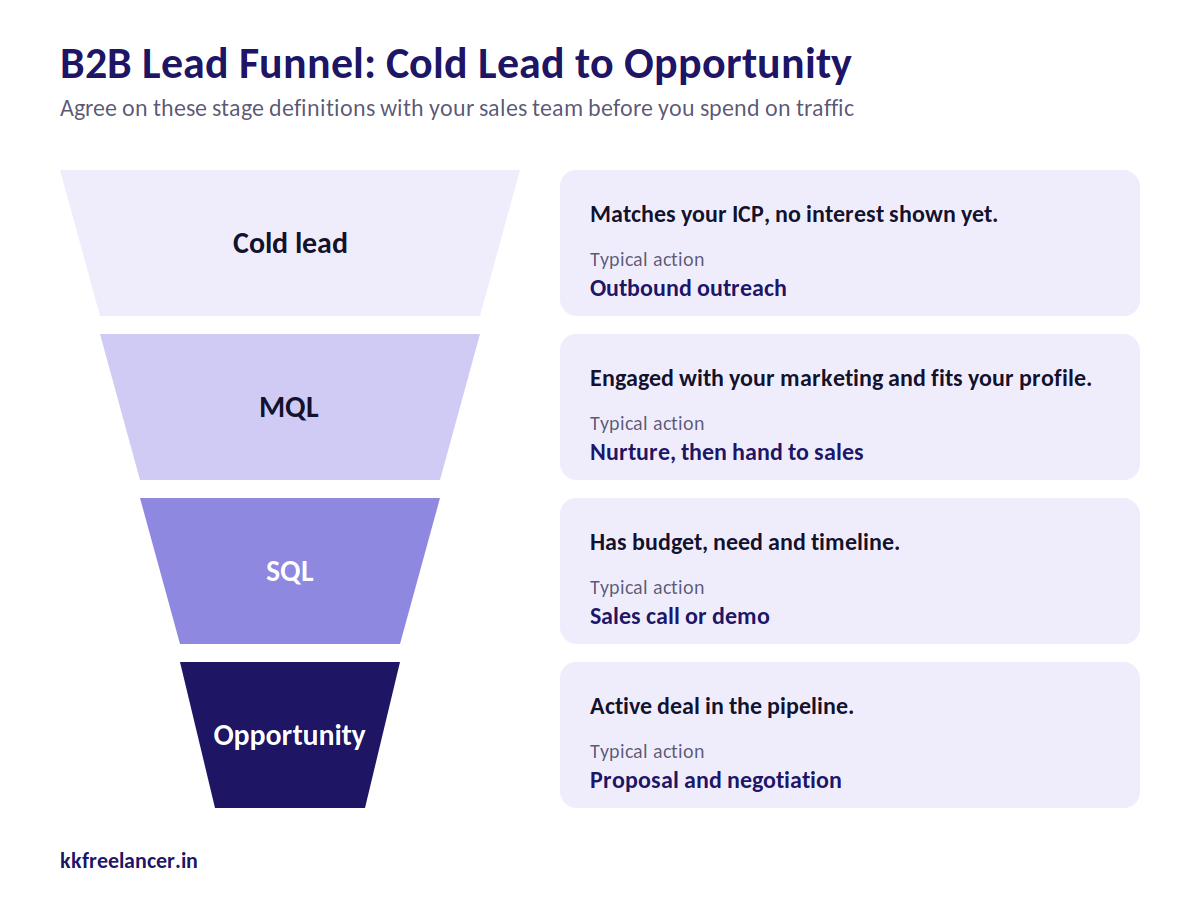
| Lead Type | Meaning | Typical Action |
|---|---|---|
| Cold lead | Matches your profile, no interest shown yet | Outbound outreach |
| MQL (marketing qualified lead) | Engaged with your marketing, fits your profile | Nurture, then hand to sales |
| SQL (sales qualified lead) | Has budget, need and timeline | Sales call or demo |
| Opportunity | Active deal in the pipeline | Proposal and negotiation |
Agree on these definitions with your sales team before you spend on traffic. Marketing and sales often argue about lead quality because nobody wrote the definition down.
Step 1: Define Your Ideal Customer Profile (ICP)
Every channel works better when it targets the right company. Your ICP is a description of the businesses most likely to buy, stay and pay well.
ICP Fields to Document
- Industry and sub-industry
- Company size (employees and revenue band)
- Location or service region
- Tech stack or tools they already use
- Trigger events such as funding, expansion, a new hire or a compliance deadline
- Decision makers and influencers (title and department)
Study your best five existing customers first. Note what they share, and what your lost deals had in common.
[Insert Real Client Case Study: ICP Refinement That Reduced Cost Per Qualified Lead]
Step 2: Build a Conversion Path Before Driving Traffic
Traffic without a conversion path is wasted spend. Build the path first, then feed it.
The Minimum Lead Capture Setup
- A focused landing page: One offer, one form, one goal. Remove the main navigation.
- A lead magnet: A resource worth giving an email address for, such as a checklist, benchmark report, template or audit.
- A short form: Name, work email, company and one qualifying question. Every extra field lowers conversions.
- A thank-you page: Confirm the next step and track the conversion here.
- A CRM: Every lead must land in one system with a source tag.
Lead Magnet Ideas That Work for B2B
- Industry benchmark report
- ROI calculator or pricing estimator
- Free website or SEO audit
- Templates and swipe files
- Webinar recordings with a Q&A
- Short email course
If you need the website and landing pages built for conversions, see our Website Designing Service.
12 Proven Ways to Generate B2B Leads
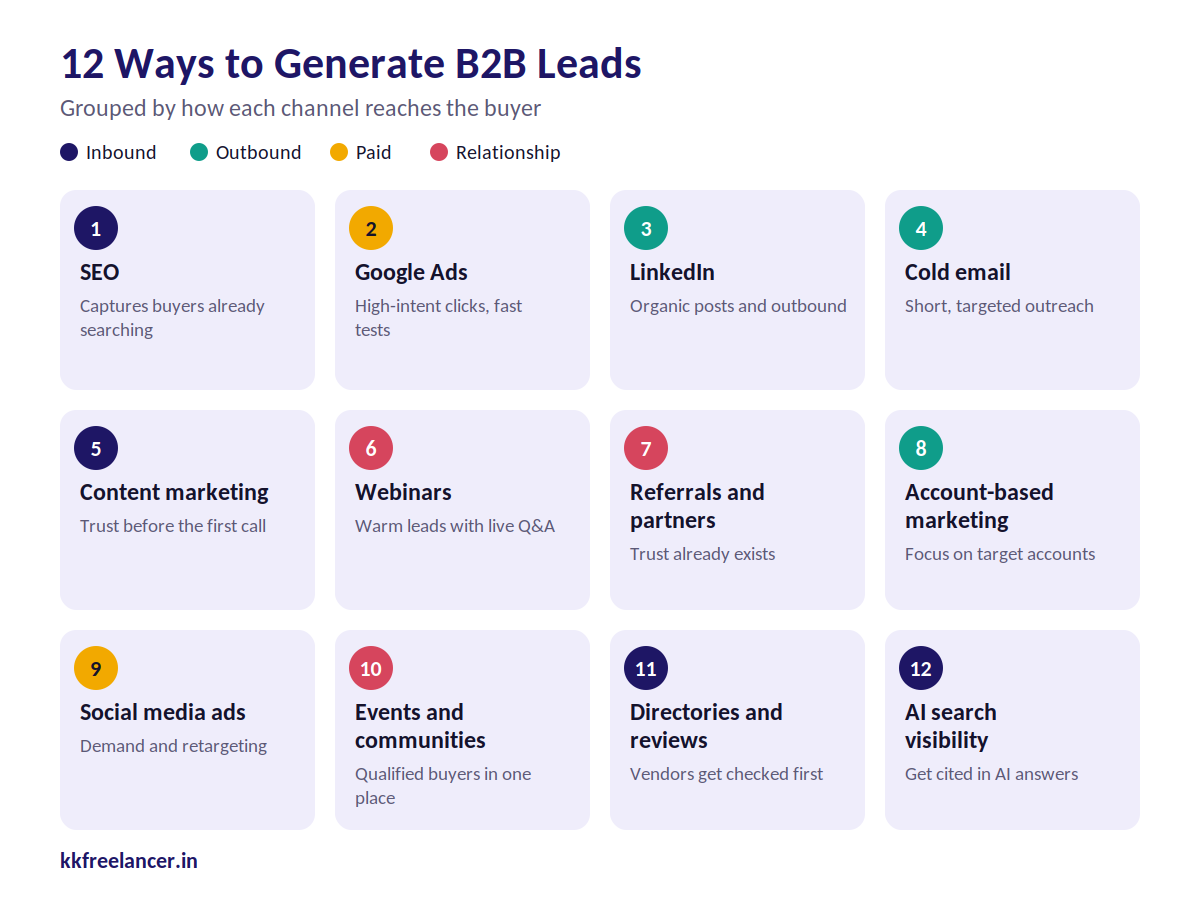
1. Search Engine Optimization (SEO)
SEO captures buyers who are already searching for a solution. It takes longer than ads, but the traffic compounds and the cost per lead tends to fall over time.
Focus on three page types:
- Service and solution pages for buying-intent keywords
- Comparison and alternative pages for people evaluating vendors
- Problem-led blog posts that earn trust early
A structured SEO Service builds these pages around keywords your buyers actually type.
2. Google Ads (Search and Remarketing)
Paid search puts you in front of high-intent prospects quickly. Bid on terms that signal a purchase, such as “software for,” “services in,” “pricing” and “vendors.”
Use these rules:
- Send traffic to a dedicated landing page, not the homepage
- Add negative keywords weekly to cut irrelevant clicks
- Track form submissions and calls as conversions
- Use remarketing to bring back visitors who did not convert
Our Google Ads Service covers account setup, tracking and ongoing optimisation.
3. LinkedIn Organic and Outbound
LinkedIn is the main B2B network in India and most other markets. Use it in two ways.
Organic: Publish practical posts from the founder and team. Share lessons, case studies and opinions, not product announcements.
Outbound: Send short, relevant connection requests, then follow up with value. Skip the pitch in the first message.
4. Cold Email Outreach
Cold email still works when it is targeted and honest. It fails when it is sent in bulk to a purchased list.
A reliable structure:
- One line on why you are writing to them specifically
- One line on the problem you solve
- One proof point
- One low-friction question
Keep emails short, use a warmed-up sending domain, and respect opt-outs and local data rules.
5. Content Marketing
Content builds trust before the first sales call. Case studies, guides and original data work best for B2B.
A simple content mix:
| Content Type | Funnel Stage | Goal |
|---|---|---|
| Problem-led blog posts | Top | Attract searchers |
| Comparison pages | Middle | Help vendor evaluation |
| Case studies | Bottom | Prove results |
| Gated reports and tools | Middle | Capture contact details |
6. Webinars and Live Sessions
A webinar lets prospects see your expertise and ask questions. It also produces warm leads who gave you 30 to 60 minutes of attention.
Promote it through email and LinkedIn, record it, and turn the recording into a gated asset. Follow up within 24 hours with the recording and a clear next step.
7. Referrals and Partnerships
Referrals close faster and convert better because trust already exists. Build a simple process instead of waiting for them.
- Ask happy customers for introductions after a successful milestone
- Partner with firms that serve your buyers without competing with you
- Offer a clear referral reward or reciprocal introductions
8. Account-Based Marketing (ABM)
ABM treats a small list of target accounts as individual markets. It suits businesses with high deal values and long sales cycles.
Steps:
- Build a list of 30 to 100 target accounts
- Map decision makers inside each account
- Run personalised ads, emails and outreach to those accounts
- Align sales and marketing on one shared goal
9. Social Media Ads (LinkedIn and Meta)
Paid social creates demand and retargets visitors. LinkedIn allows targeting by job title, industry and company size, though cost per click is usually higher than on other platforms.
Meta ads can work well for small and mid-sized business buyers, especially with a strong lead magnet. Our Social Media Ads Service is one option for this channel, but the three tracked links in this guide stay with SEO, Google Ads and CAC measurement.
10. Events, Trade Shows and Communities
Industry events put you in front of qualified buyers in one place. Online communities and industry groups do the same at lower cost.
Choose events where your ICP actually attends. Collect contacts with a clear follow-up plan, because a stack of business cards is not a pipeline.
11. Directories, Marketplaces and Review Sites
Many B2B buyers check directories and review platforms before contacting a vendor. A complete profile with recent reviews builds trust and sends qualified traffic.
Keep your business name, address, services and website consistent across every listing.
12. AI Search and Answer Engine Visibility
Buyers now ask tools like ChatGPT, Gemini and Perplexity to shortlist vendors. If your brand is not cited, you can miss prospects who never open a search result.
To improve visibility:
- Answer buyer questions directly in the first lines of a page
- Add structured data, authorship and clear company details
- Publish original data and case studies that others cite
- Keep your brand information consistent across the web
Channel Comparison: Where to Start
| Channel | Speed of Results | Cost Pattern | Best For |
|---|---|---|---|
| SEO | Slow (3 to 6+ months) | Lower per lead over time | Long-term pipeline |
| Google Ads | Fast | Pay per click | Quick testing, high intent |
| LinkedIn outbound | Fast | Mostly time and tools | High-ticket services |
| Cold email | Fast | Low | Targeted account lists |
| Content marketing | Slow to medium | Moderate | Authority and trust |
| Webinars | Medium | Moderate | Education-heavy products |
| Referrals | Medium | Low | Trust-based sales |
| ABM | Medium | High per account | Large deal sizes |
Start with one fast channel (Google Ads or outbound) and one compounding channel (SEO or content). Add more only after the first two have a clear cost per qualified lead.
[Insert Performance Screenshot Blueprint Here: Channel-Wise Lead Source Report from CRM]
Step 3: Qualify and Score Your Leads
A large lead list means little if sales cannot close it. Lead scoring helps your team focus on the best prospects first.
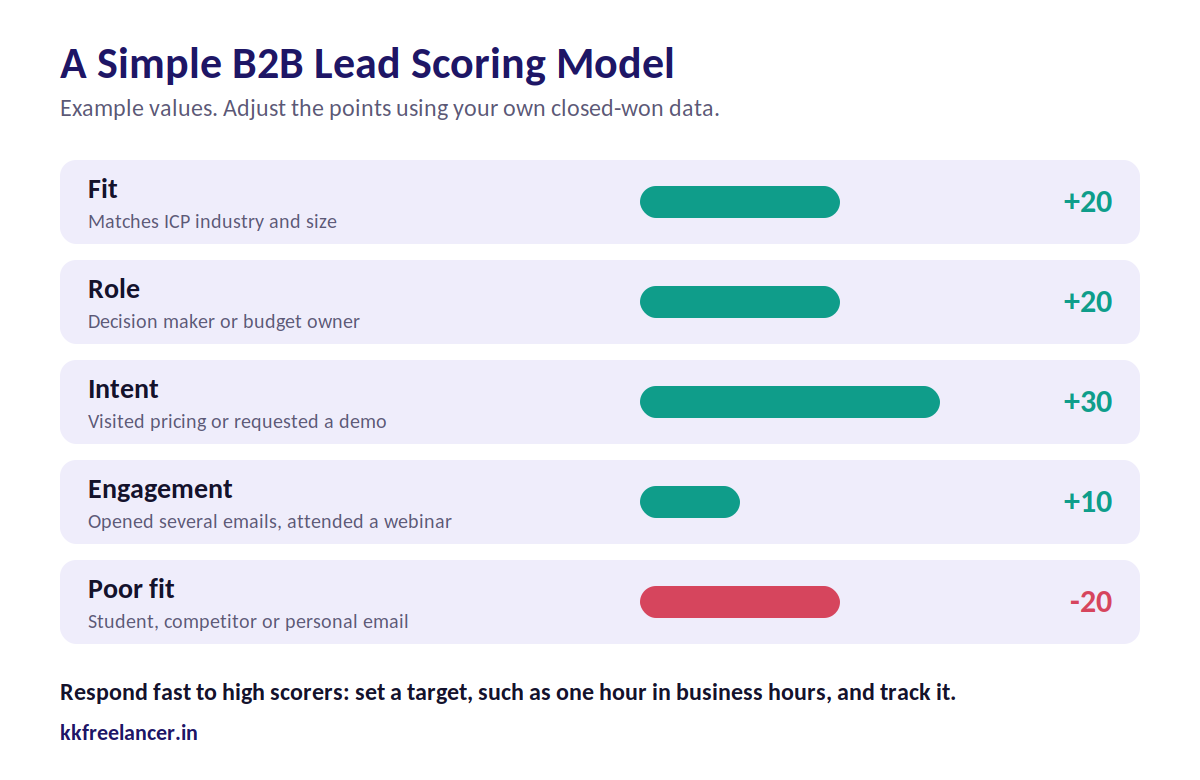
A Simple Lead Scoring Model
| Signal | Example | Points |
|---|---|---|
| Fit | Matches ICP industry and size | +20 |
| Role | Decision maker or budget owner | +20 |
| Intent | Visited pricing or requested a demo | +30 |
| Engagement | Opened several emails, attended a webinar | +10 |
| Poor fit | Student, competitor or personal email | -20 |
These point values are examples. Adjust them using your own closed-won data.
Speed-to-Lead
Respond to inbound enquiries as fast as you can. Many teams lose deals because a prospect waits a day while a competitor replies in minutes.
Set an internal target, such as responding within one hour during business hours, and track it.
Step 4: Nurture Leads Who Are Not Ready
Most B2B leads do not buy on the first visit. A nurture sequence keeps you present until they do.
- Send a short welcome email with the resource they requested
- Follow with two or three useful emails, not sales pitches
- Share a relevant case study after a few days
- Offer a call or audit once they have engaged
WhatsApp can be effective in India for follow-ups, provided the person has opted in.
Step 5: Measure the Metrics That Matter
Lead volume is a vanity number if none of the leads close. Track the full funnel.
| Metric | What It Tells You |
|---|---|
| Cost per lead (CPL) | Cost to capture one contact |
| Cost per qualified lead | Cost of a lead that fits your ICP |
| Lead-to-opportunity rate | Quality of leads reaching sales |
| Customer acquisition cost (CAC) | Total cost to win one customer |
| Sales cycle length | How long deals take to close |
| Pipeline and revenue by source | Which channel actually earns money |
Use our CPA and CAC Calculator to check whether a channel can stay profitable as you scale. Compare CAC against the lifetime value of a customer before raising any budget.
[Insert Real Client Campaign ROI Metric Here: Leads, Cost per Qualified Lead and Closed Revenue in 90 Days]
Common B2B Lead Generation Mistakes
- Targeting everyone instead of a defined ICP
- Sending paid traffic to a generic homepage
- Judging channels by lead count instead of qualified leads
- Slow follow-up on inbound enquiries
- Buying contact lists with poor data quality
- Ignoring the buying committee, where several people influence the decision
- Running too many channels with too little budget
A 30-Day Starter Plan
| Week | Focus | Output |
|---|---|---|
| 1 | ICP, offer and tracking | ICP document, CRM, analytics events |
| 2 | Landing page and lead magnet | One live page, one downloadable asset |
| 3 | Launch first channels | Google Ads campaign and outbound sequence |
| 4 | Review and adjust | Cost per qualified lead report, next-month plan |
Frequently Asked Questions
What is the best way to generate B2B leads?
There is no single best channel. SEO and content bring steady inbound leads, while Google Ads and outbound produce faster results. Most successful businesses combine one fast and one long-term channel.
How much does B2B lead generation cost?
Costs vary by industry, deal size and channel. Calculate your allowable customer acquisition cost from your average deal value and margin, then work backwards to a target cost per qualified lead.
How long does it take to see B2B leads?
Paid ads and outbound can produce leads within days or weeks. SEO usually takes several months to build momentum.
What is the difference between lead generation and demand generation?
Lead generation captures contact details from interested prospects. Demand generation builds awareness and interest so more people want to buy in the first place.
Is LinkedIn better than Google Ads for B2B?
They serve different purposes. Google Ads captures people searching now, while LinkedIn reaches specific job titles and builds familiarity before they search.
Final Takeaway
A reliable B2B lead system starts with a clear ICP, a conversion path, two well-chosen channels and honest measurement. Fix the funnel first, then scale the channel that produces qualified leads at a sustainable CAC.
Need a lead generation system built for your business? Book a free consultation with Kkfreelancer and get a channel plan matched to your market.