Introduction: Why Understanding Google Ranking Factors Matters
If you are trying to grow your business online, appear on the first page of Google, and outrank competitors, you must understand how Google decides which pages deserve to rank. Google uses more than 200 Google ranking factors for SEO, but not all carry equal weight. For business owners, marketers, and digital professionals, understanding the most important ones can dramatically improve visibility, website authority, and conversions.
Google's algorithm evaluates billions of web pages for every search query. It looks at content quality, user experiences, website strength and expertise. Knowing the top Google ranking criteria is crucial for building a long-term, strong digital presence..
This guide breaks down the top 5 Google ranking factors, and explains how to optimize each of them using simple frameworks. These ranking signals will influence your SEO strategy, whether you're a B2B or B2C company, startup, ecommerce, local business, or a B2C brand.
What Are Google Ranking Factors?
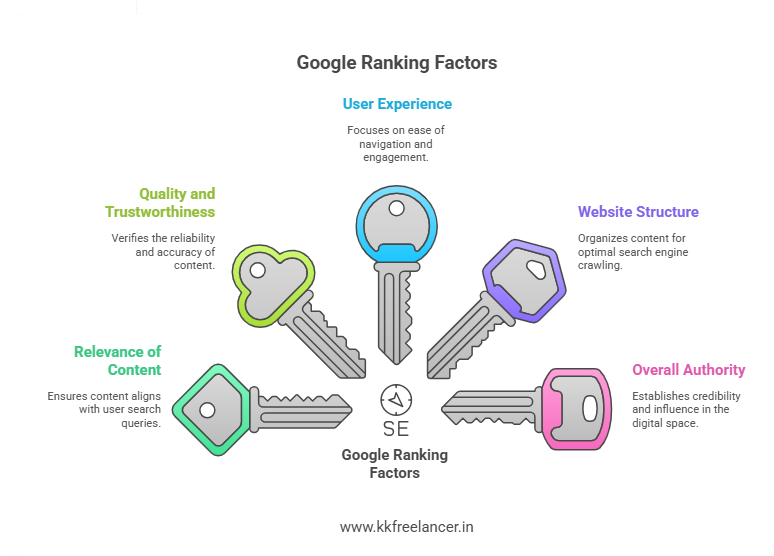
Google ranking factors are signals used by Google Search to determine which webpages best match a user’s search query. These factors help Google decide the:
- Relevance of content
- Quality and trustworthiness
- User experience
- Website structure
- Overall authority
These signals are part the Google ranking algorithm. This algorithm is constantly evolving through major updates such as Core Updates and Helpful Content Updates.
Google Search Central, Google Search documentation, and SEO experts reveal the most important factors today.
Here are the top 5 ranking factors which have consistently affected search results.
Top 5 Most Important Google Ranking Factors for SEO
1. High-Quality, Relevant, and Helpful Content
Content quality is the #1 ranking factor. If your content is not useful, original, and expert-level, nothing else can compensate for it.
Why content matters:
- Google prefers content that demonstrates Expertise, Experience, Authority, and Trust (E-E-A-T).
- Helpful content improves dwell time and decreases bounce rates.
- High-quality content increases shareability and natural backlinks.
What high-quality content includes:
- Original research
- Clear explanations
- Actionable insights
- Logical structure with headings
- User query satisfaction
Real Example:
Websites that publish "Top 10 marketing tools" with screenshots, real comparisons and expert insight are more valuable than thin articles without depth..
Actionable Tips:
- Write content that matches search intent (informational, commercial, or transactional).
- Use simple language and short sentences.
- Add examples, case studies, and statistics.
- Update older articles frequently.
The service page at kkfreelancer is a great resource for businesses that need professional SEO content.
2. Backlinks and Website Authority
Backlinks are still among the strongest ranking signals because they act as votes of trust from other websites.
Why backlinks matter:
- High-authority websites linking to you boost credibility.
- Editorial backlinks from reputable sources increase ranking strength.
- Consistent link-building improves overall domain authority.
Types of backlinks that help rankings:
- Editorial links from authoritative blogs
- Niche-relevant backlinks
- Brand mentions
- Guest posts from credible websites
- Citation links for local SEO
Stats:
Studies from authoritative SEO platforms like Ahrefs show that:
- Pages with more backlinks rank significantly higher.
- Over 90% of webpages receive zero organic traffic because they have zero backlinks.
Actionable Tips:
- Publish linkable content (stats, tools, guides).
- Perform competitor backlink gap analysis.
- Build relationships with industry bloggers.
- Avoid spammy links or automated link-building tools.
3. On-Page Optimization & Keyword Relevance
On-page SEO ensures your content is understood by both users and search engines.
Key elements of on-page SEO:
- Title tags and meta descriptions
- Structured headings (H1, H2, H3)
- Internal linking
- Image optimization
- URL structure
- Schema markup
Addressing these signals aligns your page with user intent and search engine understanding.
Actionable Tips:
- Use keywords naturally in your intro, headings, and first 100 words.
- Add internal links to relevant pages (example: link to kkfreelancer blog https://www.kkfreelancer.in/blog).
- Add schema for Article, FAQ, and Breadcrumb.
Example:
A page targeting “digital marketing services in Mumbai” should include variations like:
- digital marketing agency
- online marketing services
- SEO and PPC solutions
4. User Experience (UX) & Core Web Vitals
Google now ranks websites based on user experience metrics such as:
Core Web Vitals:
- LCP (Largest Contentful Paint): Loading speed
- FID (First Input Delay): Interactivity
- CLS (Cumulative Layout Shift): Visual stability
UX signals also include:
- Mobile-friendliness
- Fast page loading
- Easy navigation
- Low bounce rate
- Clean design
Why UX matters:
Google wants users to have a smooth, frictionless experience. Poor UX can drop rankings even if your content is strong.
Actionable Tips:
- Compress images
- Use lazy loading
- Improve mobile responsiveness
- Reduce pop-ups and intrusive ads
Read More - Core Web Vitals Complete Guide For SEO
Stats:
According to Google Research, a 1-second delay reduces conversions by 20%.
5. Technical SEO Foundation
Even the best content cannot rank if your website has technical issues.
Technical SEO includes:
- XML sitemap
- robots.txt
- HTTPS security
- Crawlability
- Canonical tags
- Structured data
- URL architecture
Why technical SEO is crucial:
Google must crawl, index, and understand your site. A weak technical foundation leads to indexing issues, poor ranking signals, and traffic loss.
Actionable Tips:
- Fix crawl errors in Google Search Console.
- Maintain a clean site structure.
- Ensure mobile-first indexing.
- Use canonical tags to prevent duplicate issues.
Read More - How to Rank Website on ChatGPT: Complete Guide for 2026
Comparison Table: Top 5 Google Ranking Factors at a Glance
| Ranking Factor | Importance Level | Impact on SEO | What It Improves |
| High-Quality Content | ⭐⭐⭐⭐⭐ | Very High | Relevance, user satisfaction |
| Backlinks & Authority | ⭐⭐⭐⭐⭐ | Very High | Trust, ranking power |
| On-Page Optimization | ⭐⭐⭐⭐ | High | Understanding, relevance |
| User Experience (UX) | ⭐⭐⭐⭐ | High | Engagement, conversions |
| Technical SEO | ⭐⭐⭐⭐ | High | Indexing, crawlability |
Additional Factors That Support Google Rankings
Although we covered the top five, there are supporting factors that also play a role:
- Internal linking structure
- Website age
- Brand trust
- Social signals
- Topical authority
- Search intent optimization
Mentioning industry-leading websites such as Moz, Search Engine Journal, Ahrefs, or Google Search Central can help you reference highly credible sources.
How to Optimize for Google Ranking Factors (2026 Blueprint)
Step 1: Build High-Quality, Helpful Content
- Create long-form guides, case studies, checklists
- Use proper formatting with headings
- Add actionable tips
Step 2: Improve On-Page SEO
Include the keywords, optimize URLs, and maintain readability.
Step 3: Build Authoritative Backlinks
Publish link-worthy content and use relationship-building.
Step 4: Strengthen Technical SEO
Fix errors, improve loading speed, and ensure a clean architecture.
Step 5: Enhance User Experience
Clean design, fast loading, mobile-first layout.
Frequently Asked Questions
The top Google ranking factors include content quality, backlinks, on-page SEO, user experience, and technical SEO
Most websites notice improvements in 3–6 months depending on competition, quality, and optimization level.
Yes. Backlinks remain a powerful signal for authority, trust, and rankings.
Yes. Faster websites create better user experiences, which improves ranking and engagement metrics.
Focus on high-quality content, follow best SEO practices, strengthen technical SEO, and build topical authority.